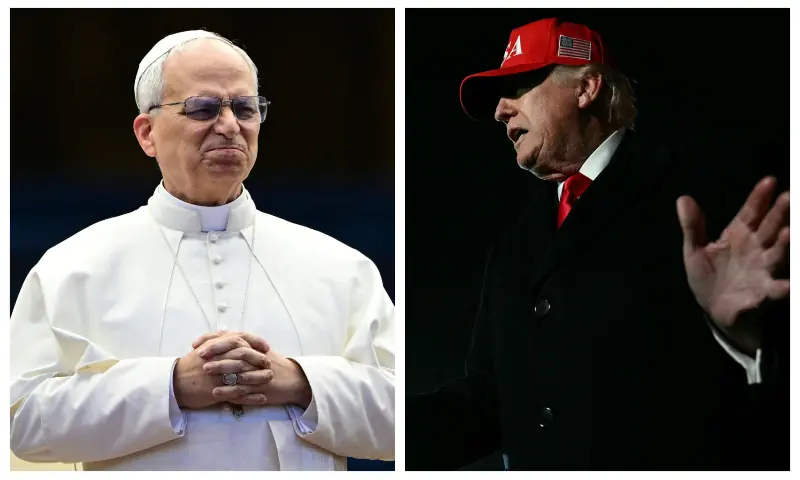
When it comes to global affairs, tension isn’t always seen through open conflicts or heated exchanges. In some cases, it’s all about the shift of tone, the change of priorities, or the omission of certain symbolic gestures otherwise expected to exist. Truth is, the relations of the Holy See with the US government are no exception to this trend; they are as much about collaboration as they are about careful distancing.
The relationship between Washington and the Vatican did not happen overnight; it has developed over a period of around one hundred years. The development was initiated by the meeting of Woodrow Wilson and Benedict XV, which took place in 1919. President Wilson was the first American head of state to visit the Vatican and initiate dialogue with the pontiff.
Nevertheless, it took another thirty years before the process of diplomatic interaction was normalized. Dwight D. Eisenhower started the trend of presidential visits to the Vatican when he visited Pope John XXIII in 1959. The meetings between representatives of the two states continued to occur and have become an integral part of international diplomacy.
That relationship only deepened further when Pope John Paul II visited Jimmy Carter in 1979. It was then that the conversations moved beyond formalities to focus on human rights and global cooperation, themes that still anchor Vatican diplomacy today.
There have been moments when the Vatican and the United States found themselves closely aligned. During the Cold War, Ronald Reagan and Pope John Paul II developed a notable partnership shaped by their shared opposition to communist rule in Eastern Europe.
Their 1982 meeting is often seen as a defining moment in this relationship. Having both survived assassination attempts the previous year, the two leaders approached global affairs with a heightened sense of urgency. While the Vatican did not describe their cooperation as a formal alliance, both sides pursued overlapping goals—particularly in their support for the Solidarity movement in Poland.
This convergence of moral and political influence contributed to broader changes across Eastern Europe, which ultimately played a role in the decline of communist governments and the eventual dissolution of the Soviet Union.
Regardless of their frequent meetings, the Vatican and the United States often have two very distinct perspectives on international affairs.
For one, the Vatican has its own set of values based on moral theology. This includes values such as human dignity, poverty, and peace. The Vatican does not limit its perspective to the boundaries of any single nation. American policymakers, on the other hand, face many concrete issues. These include issues related to national security, economic development, and immigration. Even when discussing similar topics, the Vatican and American policymakers do so from very different perspectives.
All these differences have come out into the open during the papacy of Pope Leo XIV. In particular, the direct criticism by the Pope of the United States’ foreign policies, particularly the Iran issue, represents a sharper, more vocal approach than we’ve seen in the past.
Pope Leo has been clear: violence cannot be justified by faith, and “God does not endorse war.”
This message formed an uneasy juxtaposition with the use of moral and religious language by some American politicians concerning military activities. Public tensions arose after the vice president Vance raised objections to the pope’s theological views regarding wars, and the president himself joined the debate criticizing the pontiff.
“How can you say that God is never on the side of those who wield the sword?” the vice-president said during a Turning Point USA event at the University of Georgia, as reported by The Guardian.
“Was God on the side of the Americans who liberated Holocaust camps? It’s very, very important for the pope to be careful when he talks about matters of theology … you’ve got to make sure it’s anchored in the truth.”
A day before that, JD Vance, who converted to Catholicism, urged the U.S.-born Pope Leo XIV to “stick to matters of morality” following an earlier post on X in which the pope criticized the US-Israel war in Iran.
“God does not bless any conflict. Anyone who is a disciple of Christ, the Prince of Peace, is never on the side of those who once wielded the sword and today drop bombs,” Leo wrote.
Some two weeks ago, the pope spoke to reporters while traveling aboard the papal plane en route to Cameroon for an 11-day visit to Africa. Although he avoided directly responding to JD Vance’s remarks or the recent wave of social media criticism from Donald Trump—who had described him as “weak” and “terrible”—his comments suggested the ongoing dispute remained on his mind.
The tensions, which had unfolded over five days, began when Pope Leo XIV referred to the Iran war during evening prayers at St Peter’s Basilica as being driven by a “delusion of omnipotence.”
Although it is not the first time that popes and presidents have exchanged opinions on controversial issues, analysts note that what distinguishes this particular conflict from other debates is the directness of their differences. In fact, it has been called an “inflection point”—the point at which leaders sharing a common cultural background have become poles apart.
Within the realm of diplomatic discourse, every move is interpreted. Whenever there is an absence of harmony or frequency in the discussions, it becomes easy to see whether there are any fault lines. However, just because there seems to be “perceived distance,” it does not necessarily mean that all forms of communication have ceased completely. In fact, most diplomatic activity takes place behind the scenes through ambassadors and private correspondence.
Ultimately, the connection between the Vatican and the US can be viewed as two contrasting sides of the same coin. While one side of this coin is based on the teachings of God, the other side rests on the foundation of the state.
There are times when both sides align themselves, and there are times when their interests clash with each other. However, such differences do not reflect poorly on the relationship. Rather, they indicate that there are still many lessons that moral and political influence can learn from one another.