Many of us have experienced that first jolt upon waking up as we step down from our beds. It’s the painful sensation that can make a simple trip from one end of the room to the other as uncomfortable as walking on nails.
If this resonates with you, chances are you suffer from plantar fasciitis, a prevalent ailment that results from inflammation or minuscule tears in the plantar fascia, the strong ligament that supports your arch.
The good news? Typically, you don’t have to book an appointment with a surgeon or stock up on medications to make yourself feel better.
The evidence is clear – your body’s greatest healing power comes at the end of your feet. As reported by the Journal of Orthopedic & Sports Physical Therapy (JOSPT), stretching and strengthening are the key.
In fact, there is even evidence in the literature stating that the simple use of a stretching program can bring about major improvement in more than 50% of people in a matter of weeks according to ResearchGate.
And when you combine your stretching with strength training, you build yourself a “support structure,” which will relieve tension in your foot and help regain your mobility.
Are you tired of limping around? Then take these seven scientifically proven exercises and start healing yourself.
The Seated Plantar Fascia Stretch (The “Gold Standard”)
If you only have time for one stretch, make it this one. Unlike general stretches, this one targets the exact area where the pain starts.
According to clinical research by the American Academy of Family Physicians, this stretch is often more effective for chronic cases than standard calf stretches.
- How to do it: Sit down and place the affected leg over the other at the knee. Then, hold your toes and gently pull them toward your shin.
- Goal: Hold the position for 20–30 seconds.
Quick tip: Try doing this in the morning before getting out of bed to “pre-stretch” the tissue.
The Wall-Supported Calf Stretch
We all know that our body is a chain, and most of the time, the culprit behind your heel pain is actually the calf muscle in your body. When your calf muscles are tense, they tug at the Achilles tendon, which tugs at your heel.
- How to do it: Stand with your back towards a wall, placing your arms up against the wall at the level of your eyes. Place one leg behind, ensuring that it remains straight. Bend at your waist and lean forward until there is a stretch in the rear part of your leg.
- Goal: Hold each for 30 seconds.
- Why it works: Lessening the strain on the calves results in decreased mechanical stress on your plantar fascia as explained by the Foot & Ankle Centers.
Towel Curls (The Arch Builder)
What may seem to be a mere trick actually works to activate the intrinsic muscles—those small muscles within the foot that prevent the arch from collapsing.
- How to do it: Start by sitting and placing a thin towel on the smooth floor. With just your toes, “scrunch” the towel inward. After it has been scrumpled, extend it out again and repeat.
- Why it matters: Activation of these small muscles leads to a built-in orthotic and helps relieve the fascia of the weight.
Controlled Heel Raises
Strength is the only safety net you’ll need to ensure a future free of pain. These heel raises will strengthen the calf and arch muscle groups, which will help to better distribute the load created by your body weight.
- How to do it: Stand with feet placed shoulder-width apart. Gradually raise yourself on tiptoes; hold steadily for two seconds, then lower back down.
- Goal: 2-3 sets of 10-15 repetitions.
- Scientific Proof: According to research published on PMC, strengthening muscle groups to improve load distribution is crucial in alleviating walking pain.
Marble Pickups
Like towel curls, marble pickups are another exercise that helps improve foot dexterity. The goal is to encourage the foot to move actively rather than remain passive.
- How to do it: Scatter a few marbles (or even pens or small objects) on the floor. Use your toes to pick them up one by one and place them into a container.
- Effect: Modern rehabilitation programs often include “foot core” exercises to help counter muscle imbalances that can contribute to inflammation.
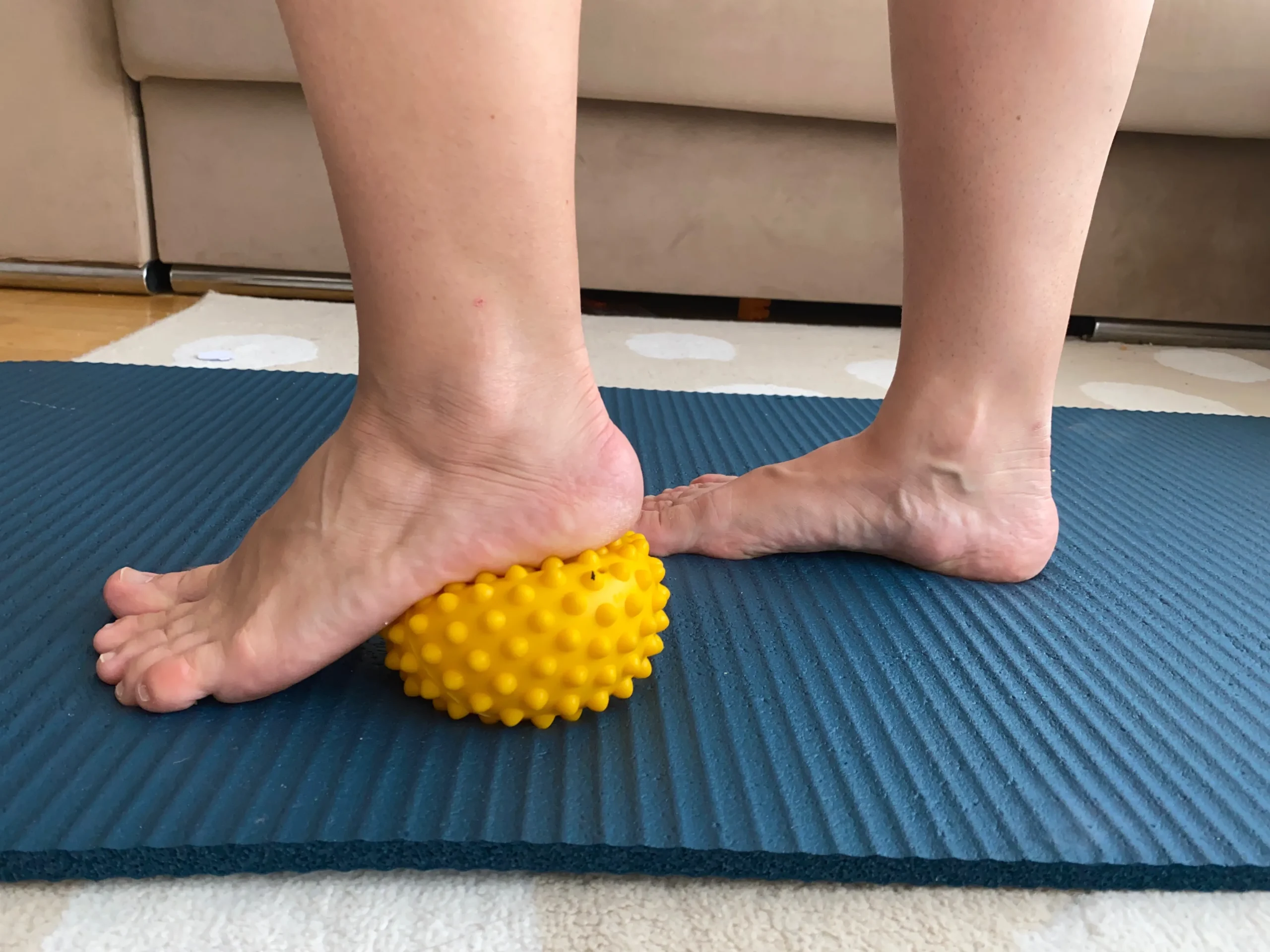
Rolling Massage (Active Release)
Although this is not strictly considered a workout, but rather a soft tissue massage technique, it plays a crucial role in the list of techniques presented here. It can be seen as a kind of “kneading out” of the knots in the foundation of your foot.
- How to do it: Sit on a chair and place either a tennis ball, lacrosse ball, or even a frozen water bottle underneath your foot, and roll it from your heel to the base of your toe.
- The advantage: It will enhance blood circulation in that particular area and give you temporary neurological pain relief, which will make subsequent stretches easier.
The Short Foot Exercise
It is the “plank” exercise for feet. It may look simple, but it is highly effective in firing up the muscles supporting your arches.
- How to do it: Place your foot flat on the floor. Then, pull the ball of your foot towards your heel without flexing your toes. The foot becomes shorter while the arch lifts.
- Goal: Maintain the arch lifting for 5 seconds before resting.
- Purpose: This exercise strengthens the foot structure so that there will be no collapsing of arches, which usually leads to plantar fasciitis pain.
Why This Works
While the suffix “-itis” implies active inflammation, recent sports medicine research shows that chronic heel pain should be referred to as plantar fasciosis because it involves more than simply inflammation of the tissues.
Your foot is truly an architectural masterpiece and the plantar fascia is the “string” of the foot “bow.” If you do not have proper muscle support or your foot’s “strings” are too tight, then you are putting them under extreme strain.
Numerous studies suggest that treating symptoms without addressing the underlying mechanics is like bailing water out of a leaking boat without fixing the hole.
- Stretching (the “release”): Tightness in the calf muscles and the plantar fascia increases tension. Stretching helps reduce this tension and signals the nervous system to relax.
- Strengthening (the “shield”): Exercises such as high-load strength training—for example, heel raises with a towel under your toes—help train the body to tolerate greater load. Over time, this encourages the tissue to adapt and become stronger through a process known as mechanotransduction.
Your Road to Recovery
The road to recovery isn’t always a straight line, but it is predictable based on research data. Most evidence-based programs suggest a timeframe of 4–8 weeks for meaningful structural changes to occur. Think of it like preparing for a 5K—you can’t rush the body’s adaptation process.
- Stretching (2–3 times per day): Targets “first-step” pain. By stretching your calves and toes before getting out of bed, you reduce the risk of micro-tears caused by suddenly loading cold, stiff tissue.
- Strength training (1–2 times per day): This involves progressive overload. Start gradually—the goal is to activate the muscles without triggering a flare-up that carries into the next day.
Conclusion
Heel pain isn’t just physical—it can become mentally exhausting, turning something as simple as a walk in the park into something you have to think twice about.
It’s frustrating when “quick fixes” like expensive inserts or ice packs only offer short-term relief.
By focusing on a steady routine of stretching and strengthening, you’re not just covering up the pain—you’re working on the root of the problem.
Be patient with your feet; they’ve carried you a long way. With a consistent, research-based approach, you’re not only moving toward recovery—you’re helping make sure the pain doesn’t come back.