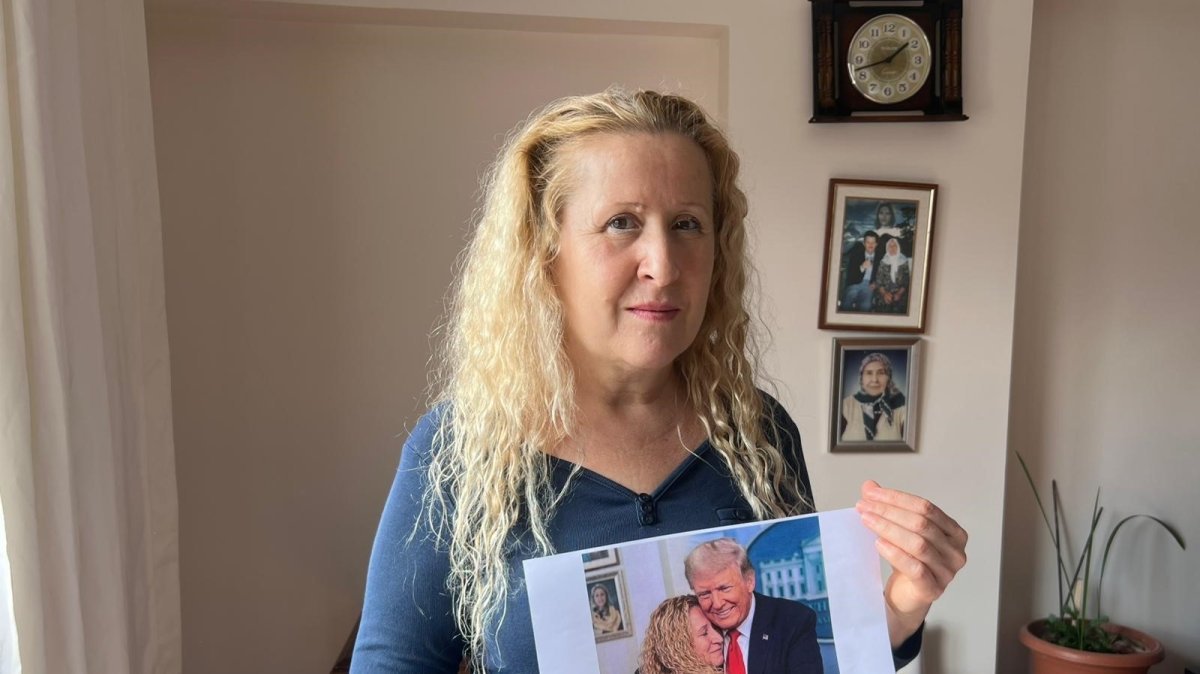
A Turkish woman has stepped forward, publicly stating that she believes she is Donald Trump’s daughter and calling for a DNA test to prove it. The claim has sparked curiosity, skepticism, and widespread discussion across global media.
At the center of the story is Necla Özmen, a woman in her mid-50s who says her mother had a relationship decades ago with Donald Trump.
According to her, the only way to settle the question once and for all is through scientific testing.
While the claim itself is unverified, it raises interesting questions about identity, proof, and the way modern media handles personal allegations involving high-profile individuals.
The story began circulating after Necla Özmen publicly alleged that she is the biological child of Donald Trump.
According to reports, she believes her mother had a connection with Trump many years ago, long before he entered politics and became one of the most recognizable figures in the world.
What makes the situation particularly striking is not just the claim itself, but the confidence with which it has been presented.
Özmen has reportedly called for a formal DNA test, framing it as the only reliable way to confirm or deny her belief.
Naturally, the claim has drawn attention across multiple news outlets. Some have treated it as a developing story, while others have leaned into its unusual nature.
Regardless of tone, this is a personal allegation that has not yet been substantiated with evidence.
At the same time, there has been no confirmed response from Donald Trump or his representatives regarding the claim.
That silence leaves the story in an unresolved state, where curiosity continues to grow but concrete answers remain out of reach.
Who Is Necla Özmen?
To understand the story fully, it helps to look more closely at the person behind the claim. Necla Özmen is not a widely known public figure. In fact, before this allegation, she had little to no international media presence.
From available reports, she is described as a Turkish woman in her 50s who has come forward with a deeply personal belief about her identity.
While details about her background remain limited, the central focus of her story revolves around her mother’s alleged past connection to Donald Trump.
This lack of public history makes the situation more complex. On one hand, it leaves room for questions about credibility and verification.
On the other hand, it reflects a broader reality. Many paternity cases, especially those that surface later in life, often involve individuals who have lived outside the public eye.
It is also worth noting that late-life identity claims are not entirely uncommon. People sometimes revisit family histories, uncover new information, or begin to question long-held assumptions about their origins. In those cases, the search for answers can become deeply personal and emotionally charged.
The Role of a DNA Test in Paternity Claims
DNA testing has become the standard for determining biological relationships, offering a level of certainty that was not possible in the past.
A standard paternity test compares specific genetic markers between two individuals. If the markers align in the expected way, the probability of a biological relationship can exceed 99.9 percent. Conversely, a mismatch can definitely rule out paternity.
In this case, Özmen’s call for a DNA test reflects a desire for clarity. Rather than relying on memory or circumstantial evidence, she is pointing toward a method that can provide a clear and objective result.
However, there is an important limitation. A DNA test requires participation from both parties. Without cooperation from Donald Trump or access to his verified genetic material, the test cannot proceed in a straightforward way.
This raises a key question. Even if one party is willing to undergo testing, what happens if the other is not? In many cases, legal processes can come into play, but those typically require formal filings and supporting evidence before a court will intervene.
One of the biggest obstacles in cases like this is the passage of time. When a claim involves events that allegedly took place decades ago, verifying details becomes much more difficult. Memories can fade or change.
Records may be incomplete or unavailable. Witnesses may no longer be reachable. All of these factors make it harder to build a clear and reliable picture of what happened.
In addition, public figures often have complex histories. Over the years, they may have traveled extensively, met countless people, and lived highly visible lives.
Sorting through that history to verify a specific claim requires substantial evidence. This is why DNA testing becomes so important. It bypasses many of the uncertainties associated with memory and documentation, offering a direct answer based on biological data.
Legal and Ethical Considerations
Paternity claims involving public figures can raise a range of legal and ethical questions. For example, does an individual have the right to request a DNA test from someone else? Under what circumstances can a court require testing?
In many jurisdictions, courts will consider ordering a paternity test if there is a compelling reason and some level of supporting evidence.
However, these cases are rarely straightforward. They often involve balancing the rights of both parties, including privacy concerns.
Ethically, the situation can also be complex. On one hand, an individual may feel a strong need to understand their biological origins.
On the other hand, the person being asked to participate may have reasons for declining. These tensions do not have easy answers, which is why many such cases remain unresolved unless both sides agree to testing.
When a story like this emerges, it is easy to focus only on the headline. However, beneath the surface, there is often a deeper psychological layer.
Late-life paternity claims are not just about public figures or media attention. They are often rooted in personal identity and a desire for closure.
For many people, understanding where they come from is a fundamental part of self-awareness. When there are gaps in that story, those gaps can become more noticeable over time.
As people age, they may begin to revisit earlier assumptions about their family history. In some cases, new information surfaces. In others, long-standing doubts become harder to ignore.
This does not mean every claim is accurate. However, it does explain why someone might feel strongly enough to pursue answers, even decades later.
The emotional weight behind these situations can be significant, especially if the person believes they have been missing a key piece of their identity.
There is another reason why this story has gained traction so quickly. It involves a global figure. Donald Trump is not just a former president.
He has spent decades in the public eye, from business ventures to television to politics. Because of that visibility, anything connected to his personal life tends to attract attention.
People feel a sense of familiarity with public figures, even though that familiarity is often one-sided. When a new claim surfaces, especially one tied to family, it taps into that sense of curiosity.
This phenomenon is not unique to Trump. Similar stories have emerged around other well-known individuals over the years.
Trump’s global recognition amplifies the reach of any story linked to him. Public curiosity can also blur the line between interest and assumption.
When a claim spreads widely, it can begin to feel more credible simply because it is being discussed so often. However, repetition does not equal verification. The underlying facts still matter, regardless of how widely the story circulates.
Modern media plays a significant role in how stories like this unfold. Once a claim is published by one outlet, it often gets picked up by others.
Each version may present the information slightly differently, but the core narrative remains the same.
This creates a ripple effect. The story appears in multiple places, across different platforms, reaching audiences in different countries. As a result, it can feel like a major development, even if no new evidence has been introduced.
The Science of DNA Testing and the Legal Process
While the story itself is complex, the science behind resolving it is relatively straightforward.
DNA testing has become one of the most reliable tools for determining biological relationships.
Every person inherits half of their DNA from each parent. That genetic information contains markers that can be compared between individuals.
In a paternity test, scientists examine these markers to see if they match in a way that would indicate a biological connection.
If the markers align as expected, the probability of paternity is extremely high, often above 99.9 percent. If they do not align, paternity can be ruled out with certainty.
This level of accuracy is why DNA testing is considered the gold standard in these cases. It removes much of the uncertainty that comes with memory, documentation, or personal accounts.
However, as mentioned earlier, the process requires participation. Without access to Donald Trump’s DNA or a verified sample, the test cannot proceed in a meaningful way. That limitation keeps the situation unresolved for now.
A claim like this could move into the legal system. Courts in many countries have procedures for handling paternity disputes, but those cases typically require more than a public statement.
To initiate legal action, a claimant usually needs to present some form of supporting evidence. That could include documentation, testimony, or other material that suggests a plausible connection. Without that, courts are less likely to compel someone to undergo testing.
Even when cases do move forward, they can take time. Legal processes involve multiple steps, including filings, hearings, and potential appeals.
In situations involving public figures, there may also be additional considerations around jurisdiction and privacy.
At this stage, there is no confirmed indication that such a process has begun in this case. That means the situation remains in the realm of public discussion rather than legal resolution.
The Public’s Reaction
As expected, the story has generated a wide range of reactions. Some people express curiosity, wondering whether the claim could be true.
Others respond with skepticism, pointing to the lack of evidence and the timing of the allegation. Social media has played a major role in shaping these reactions.
Platforms allow users to share opinions quickly, often without full context. This can lead to a mix of informed discussion and speculation.
Interestingly, the debate often extends beyond the specifics of the claim. It touches on broader themes, such as trust in media, the reliability of personal accounts, and the nature of celebrity culture.
This kind of response is common in high-profile cases. People are not just reacting to the story itself. They are also engaging with the larger ideas it represents.
What Happens Next?
For now, the situation remains unresolved. There has been no DNA test, no confirmed evidence, and no official response from Donald Trump.
That leaves a few possible paths forward. The claim could fade from public attention if no new information emerges.
Alternatively, it could develop further if additional evidence is presented or if a DNA test becomes possible.
In some cases, stories like this resurface over time, especially if new details come to light. In others, they remain unanswered, becoming part of the broader landscape of unverified claims. It is impossible to predict which direction this story will take.
A Story Still Waiting for Answers
At this stage, the claim that Necla Özmen is Donald Trump’s daughter remains unverified. There is no publicly available evidence confirming a biological connection, and no DNA test has been conducted.
That leaves the story in a state of uncertainty. It is a claim that has captured attention, but one that still lacks the proof needed to move from speculation to fact.
For now, the only definitive path forward would be a DNA test. Until that happens, the story will likely remain a topic of discussion rather than a confirmed reality.