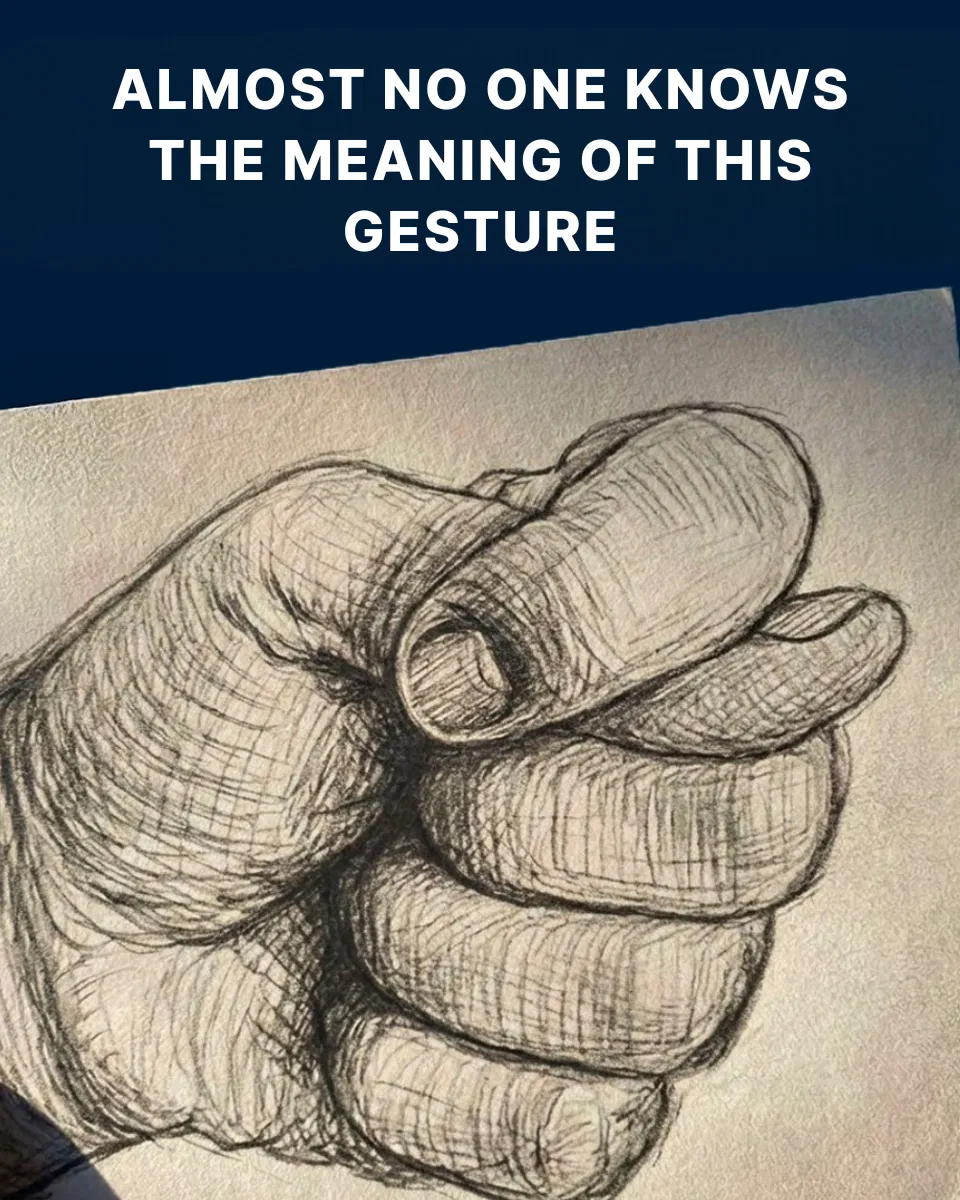

A simple closed fist. Nothing more ordinary, you might think. And yet… Slip your thumb between your index and middle fingers, and that small movement suddenly takes on meaning.
Behind this almost childlike gesture lies a surprising history, spanning centuries and cultures. A symbol of protection, a teasing sign, a quiet ritual—the “fig” gesture hasn’t said its last word.
The fig: an ancient gesture with many meanings
At first glance, the “fig” looks like nothing more than a clenched fist. But the detail of the thumb tucked between two fingers changes everything. In Greece, in particular, this gesture was once used as an ironic way of saying “you’ll get nothing” or “move along,” without uttering a single word.
At a time when exchanges could quickly become tense, this sign allowed someone to express a clear refusal without raising their voice. A silent “no,” almost elegant—like gently closing a door instead of slamming it.
This discreet body language was part of everyday life. People used it between neighbors, among friends, even within families. The gesture spoke for itself, and its message was instantly understood.
A protective symbol from long ago
But the history of the fig doesn’t stop at playful mockery. In certain ancient traditions of Eastern Europe—particularly in pagan Russia—this gesture was considered a sign of protection.
The closed fist symbolized inner strength. The tucked thumb acted as a discreet talisman. People believed the gesture could ward off negative energies and shield the person making it.
Much like our modern little rituals—knocking on wood or crossing our fingers—the fig represented a comforting way to regain a sense of control in the face of uncertainty. A tiny gesture, yet full of intention.

A secret code in the schoolyard
If you grew up before smartphones took over, you may remember those small coded gestures exchanged in the schoolyard. The fig was part of that shared language.
Missed a meetup? Playing a prank on a friend? You’d raise your hand, thumb hidden between your fingers, and the message got across. It wasn’t aggressive or vulgar—just a playful way of saying, “Nice try!”
What’s fascinating is how it was passed down. Without any manual or official explanation, the gesture traveled from one generation to the next. Like a grandmother’s recipe or a nursery rhyme, it settled naturally into daily habits.
A gesture filled with emotion in difficult times
Over time, the fig also took on a more intimate meaning. During certain troubled periods in European history, accounts describe the gesture as a symbol of endurance.
Some men would clasp a wedding ring or a small cherished object in their fist while forming the fig. It wasn’t a challenge thrown at the world, but a silent reminder of what mattered most: love, courage, hope.
Far removed from simple teasing, the gesture here became personal—almost meditative. A way of telling oneself quietly, “I’m holding on.”
A truly ancestral gesture that became a discreet refuge.

Why has the fig almost disappeared?
Today, our refusals come in the form of a voice message, an emoji, or a GIF. Digital language has replaced many of our physical codes, and the fig has become less common.
Yet it hasn’t disappeared entirely. You can still find it as a small good-luck charm or in certain families where the tradition quietly lives on.
What has evolved is not our need to express refusal or protect ourselves, but the form it takes. The underlying purpose remains the same: we are always looking for subtle ways to assert our boundaries without creating conflict.
And perhaps, at its core, the fig reminds us that we can say no calmly, protect our space gently, and affirm our strength through a simple symbol of protection… without ever raising our voice.