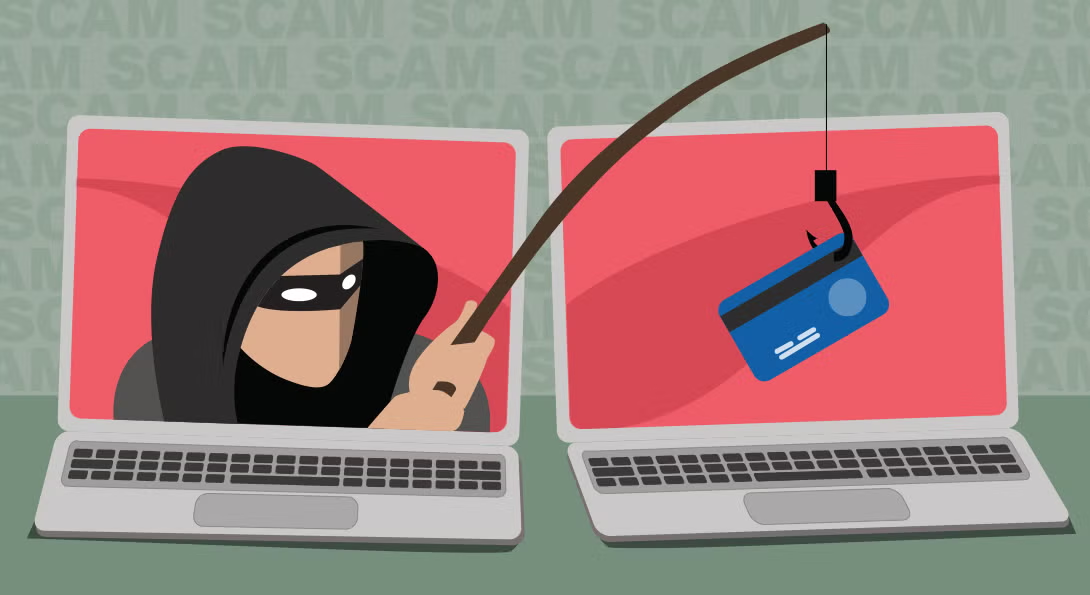
Throughout all my life, I always tried to find shortcuts, like I’ve always wanted to be smarter, richer, more attractive, happier, and more successful with just a minimal effort. To be honest with you? Shortcuts don’t really exist, and I learned that the hard way.
Many of the most important life lessons are not found in the latest self-help books or some viral productivity tips people tend to follow like crazy.
No, the most important life lessons are learned when you take the time to reflect your actions and choices, when you start paying attention about the things happening around you, and when you put yourself on the top of the list of your priorities.
One of the concepts I continue to find valuable is based on ideas commonly associated with the great Albert Einstein.
While Einstein is best known for for his contributions to physics, his ideas on curiosity, imagination, and critical thinking transcend the boundaries of physics. They are important to how we live our lives, how we interact with others, and how we avoid being taken advantage of.
Honestly, I’ve never found these ideas more relevant than I do now, especially in the face of the ease with which people are taken advantage of nowadays, especially online.
Keep Moving, Keep Learning
Einstein once said that life is like riding a bicycle: in order to stay upright, one must keep moving forward. I have come to realize that this is true in more ways than one. If I stop learning, stop challenging myself, or stop observing the world around me, then I become vulnerable—not just to stagnation but also to people who seek to take advantage of me.
Scammers usually prey on people who are not paying attention or who are stuck in life. In 2022 alone, Americans lost over $8.8 billion to fraud, according to the Federal Trade Commission (FTC) source.
Scams usually work because they tap into human instincts that are common to all people. These include our innate desire for instant gratification, our tendency to trust others, or our fear of missing out. I have come to realize that one of the best ways to protect myself is to stay curious, stay alert, and stay in the mode of learning.
Even something as mundane as reading the news about things that do not usually concern me helps me realize when people are trying to manipulate me. Knowledge is power.
Imagination and Critical Thinking
However, it is not just facts that can keep you safe. Imagination, which is the ability to see possibilities and outcomes, and to be creative, is a very important tool. For instance, if I start getting emails claiming I won a prize, or that someone has compromised my email account, I not only check if it is grammatically incorrect, but I also use my imagination and ask, “How would they contact me if it were true?” and “Does it make sense?” Most scams fall apart if you use your imagination and critical thinking.
Scientists who studied phishing scams have found that critical thinking can significantly decrease the chances of falling prey to online scams.
Mistakes Are Teachers
One thing I have had to learn the hard way is that mistakes are not the end of the world. I have been scammed once or twice. But who hasn’t? What I now know is that those experienced taught me more than any book ever could.
For example, I once clicked on a link that promised free concert tickets. Immediately, my banking app alerted me of suspicious activity, and I froze. I didn’t lose any money only because my bank was able to stop the transaction. At that moment, I felt embarrassed, but in retrospect, I realized that this mistake was a learning experience. I learned to watch for red flags: unexpected urgency, appeals to emotion, and requests for personal data.
Mistakes are simply experience turned into wisdom. Every time I make a mistake or almost get caught up in something, I take the time to write it down and think about it. It’s a sort of personal security journal, and over time, it becomes an armor of practical knowledge.
Open Minds, Sharp Eyes
One thing I have learned is that minds that are closed are easy targets for scammers. Minds that believe what they hear without questioning it, whether it is in emails, on social media, or even from friends, are easy targets for scammers. I believe in approaching everything with an open mind and asking myself questions such as:
- “Does this add up?”
- “Have I seen this information contradicted elsewhere?”
- “What is this person’s motive for sending this information?”
An open mind is not the same as being gullible. Having an open mind is being inquisitive and discerning. If I am unsure about something or something doesn’t add up, I take the time to look into it further. Einstein’s theory of independent thinking is helpful in this situation because I am to question what I am told, even by “trusted” sources.
Contribution Over Status
I have also learned that those people who’ll do anything to attain their status, likes, and followers, are easier to be scammed. This is because scammers know how to take advantage of our need to be successful or powerful. They offer us shortcuts, exclusive deals, and membership in elite groups.
Instead of chasing status, I try helping others and make contributions. This isn’t only good for your character, but also for your security. When your focus is not on how you are seen, you are less likely to be swayed by empty promises.
Spotting Inconsistencies
Another favorite tool of mine is looking for inconsistencies. I’ve found that most scams are not very good at this because they often change stories or contradict themselves in some way. They also often create a sense of urgency that just isn’t there in real life. So, when I see this kind of thing happen, I take a moment to look deeper.
For instance, I was offered an investment that guaranteed me my return in just one week. It was almost too good an offer to be true. By asking questions and verifying their credentials, I was quickly able to see that they weren’t even registered with the SEC.
Simplicity Supports Happiness
Interestingly, the simpler and more grounded I stay, the better it is for my piece of mind and my pocket. The more I yearn about something complicated and luxurious, or a “life hack” that seems too good to be true, the more I become a victim of scams.
On the other hand, I emphasize the importance of the basics in life: nurturing good relationships, learning new things, and living a simple life. Happiness does not lie in having everything; it lies in needing less, enjoying more, and not being fooled by scams that promise the opposite.
Daily Habits That Help
Some practical habits I developed over the years that help me stay alert of scammers are:
- Ask at least one question every day
- Accept your mistakes as part of learning
- Seek context before you form opinions
- Read outside my professional or comfort zone
- Simplify decisions by focusing on the essentials
- Notice if words align with actions
How to Recognize Warning Signs of Scams
Now, let’s discuss scams in particular. The first thing I usually ask myself is: “Is this a scam, and how can I spot it?” Some obvious warning signs are:
- Unsolicited offers: Did you receive the message or email unsolicited? Scammers usually contact strangers.
- Urgency tactics: “Act now, or you’ll miss out!” is a typical scammer’s trick.
- Too-good-to-be-true deals: Offers of guaranteed profits or free high-end products are usually a scam.
- Requests for personal data: Never provide passwords, bank accounts, or personal identification without verification.
- Inconsistencies: As I already said, information that keeps changing or doesn’t make sense is usually a warning sign.
I’ve learned that taking a minute to think about the situation and questioning it usually helps me avoid scams. Research by the University of Cambridge has also shown that taking a minute to think about the situation can help avoid scams source.
How to Avoid Being Scammed in the Future
The second question I ask myself is: “What habits protect me going forward?” Here’s what’s worked for me:
Check everything out before sending money or clicking on a link.
Keep your software and devices up to date – many scams target people with outdated technology.
Learn about common scams – sites like the FTC Consumer Protection
are great resources.
Set boundaries online – don’t post too much personal information on social media sites.
Trust your instincts – if it seems fishy, it probably is.
These habits have become second nature to me. Now, when I see a fishy message, I don’t freak out. I take a deep breath and make informed decisions.
Why Curiosity and Reflection Matter
Einstein’s teachings on curiosity, imagination, and learning are not just theoretical concepts. They are also useful techniques that allow me to make sense of a world where information is often distorted and manipulated.
By being curious, I ask questions that I would not have asked before. By analyzing my mistakes, I develop resilience. By thinking for myself, I can avoid echo chambers that make it easier to fall for scams.
Even the act of journaling or recording observations is helpful. By recording observations of inconsistencies, patterns, or suspicious activity, I train my brain to spot warning signs more easily.