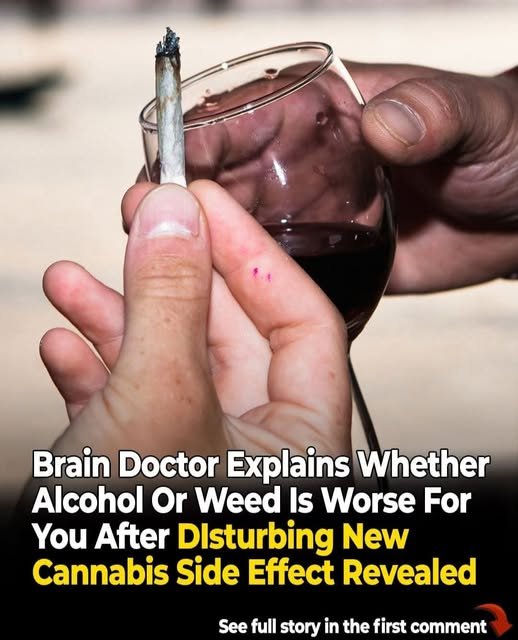
For years, the Alcohol vs. Cannabis debate seemed settled for many people. Alcohol was viewed as the obvious villain, linked to violence, addiction, liver disease, and fatal crashes. Cannabis, by contrast, gained a reputation as the safer option, especially as legalization spread and medical use expanded. Yet psychiatrist Dr Daniel Amen says that assumption deserves serious reconsideration. His brain imaging research suggests that cannabis may cause more serious long-term damage than many people expect, even when compared with alcohol.
Dr Amen, founder of Amen Clinics and a leading voice in brain health research, recently revisited this comparison in a public discussion. “Now those of you who follow me know neither one are good for you,” he said. “And quite frankly, there are more deaths every year from alcohol than there are marijuana.” He acknowledged alcohol’s devastating toll, adding, “There’s more domestic violence, there’s more drunk driving accidents, there’s more bad decisions, people ending up in jail.” However, his own data complicates the idea that cannabis is the safer choice.
Dr Daniel Amen’s brain scan findings
Dr Daniel Amen’s work relies on single-photon emission computed tomography, or SPECT imaging, which measures blood flow and activity patterns in the brain. Using tens of thousands of scans, his team examined how different substances affect aging in key brain regions. “We did a study where we evaluated 62,454 spec scans, and then we looked at how the brain ages,” he said. The results showed accelerated brain aging in people who regularly used alcohol or cannabis. Surprisingly, cannabis produced the strongest association. Dr Amen has emphasized that accelerated brain aging is not a cosmetic issue.
Reduced blood flow and activity in certain brain areas are linked to poorer memory, impaired judgment, emotional instability, and a higher risk of neurodegenerative disease. In the study, cannabis users showed widespread reductions in blood flow across multiple regions, including areas tied to motivation and impulse control. Amen has repeatedly warned that damage in these areas can quietly undermine mental health, even in people who appear functional. While alcohol remains responsible for more deaths each year, Dr Amen argues that cannabis carries a different kind of risk. Alcohol often produces visible crises, such as accidents or arrests. Cannabis, in contrast, may slowly erode brain health over time. That distinction matters for psychiatrists, especially as high-potency products become more common and daily use increases among younger adults who assume long-term harm is unlikely.
A frightening new side effect puts cannabis in the spotlight
At the same time, emergency departments across several countries report more patients arriving with a cannabis-related condition that causes violent vomiting, nicknamed “scromiting.” Doctors first described cannabinoid hyperemesis syndrome more than a decade ago, but many clinicians still missed it. Cleveland Clinic explains that CHS happens when people experience cycles of nausea, vomiting, and abdominal pain after using cannabis for a long time. Patients often arrive in severe distress, unable to stop vomiting and sometimes screaming from pain, which inspired the slang term “scromiting.” Cedars-Sinai notes that CHS is a condition that leads to repeated and severe bouts of nausea, vomiting, and abdominal pain in daily, long-term users. In October 2025, the World Health Organization assigned CHS its own diagnostic code, and the United States health system adopted the same entry. This step means hospitals can finally track CHS systematically and separate it from other vomiting illnesses.
A recent review found that emergency departments now record rising CHS diagnoses, especially among younger adults who use high-potency cannabis frequently. They warned that patients often dismiss persistent vomiting as food poisoning or anxiety. In their view, recognising CHS early helps people link terrifying symptoms to heavy cannabis use. That professional warning has helped push this once obscure syndrome into mainstream discussion. For psychiatrists, CHS is a wake-up call. A drug widely promoted as an anti-nausea remedy can, in some users, trigger relentless vomiting that only stops when cannabis use ends. That contradiction helps challenge simplistic claims that one substance is inherently safe and the other is not.
What smoking weed does to your heart
For many people, the truly shocking news involves the heart, not the stomach. At a 2025 scientific meeting of the American College of Cardiology, researchers presented a retrospective study. It included more than 4.6 million adults younger than 50. Cannabis users in this group were over 6 times more likely to suffer a heart attack than non-users. The same analysis found a 4-fold increase in ischemic stroke and a 2-fold increase in heart failure. It also showed a sharply higher risk of serious cardiovascular events, including heart attack or stroke. Study leader Dr Ibrahim Kamel said that clinicians should always ask about cannabis use when they assess cardiovascular risk. A separate meta-analysis of 12 studies, also presented by the American College of Cardiology, examined active cannabis users.
Those users were about 1.5 times as likely to have a heart attack as people who did not use cannabis. A global review from researchers at the University of Toulouse suggested that cannabis use may double the risk of death from cardiovascular disease. The same review reported a 20% increase in stroke risk among cannabis users. Cardiologists suspect several mechanisms, including increased heart rate and damage to the blood vessel lining. These findings directly challenge the casual idea that a joint offers a harmless way to relax after work. Importantly, the researchers controlled for factors like tobacco use and obesity where possible. That approach strengthens the signal that cannabis itself may drive extra cardiovascular risk. Experts also stress that many participants were still relatively young adults with otherwise good health. Seeing heart attacks in people under 50 makes clinicians pay very close attention.
Lungs, blood vessels, and the myth of a “gentler” smoke
Many people argue that cannabis smoke must be less harmful than tobacco smoke. Heart surgeon Dr Jeremy London gives a blunt answer. He tells his patients that lungs have one simple function, which is to move air in and out efficiently, and that anything else is potentially harmful. In his operating theatre, he has described operating on multiple patients who smoked marijuana regularly, whose lungs looked totally black, as if they had worked in a coal mine, despite never smoking cigarettes. Those patients had such severe blockages that they needed to undergo bypass surgery.
Research backs his concern. The American Lung Association cautions the public against smoking marijuana because of the risk of damage to the lungs. The United States Centers for Disease Control and Prevention similarly warns that smoked cannabis can harm lung tissues and cause scarring and damage to small blood vessels. These harms matter for mental health as well, because low oxygen levels and chronic inflammation affect brain function and mood. Psychiatrists increasingly remind patients that inhaling any burning plant material, whether tobacco or cannabis, pushes toxins, fine particles, and carcinogens directly into delicate lung tissue and the bloodstream. This is markedly different from an occasional prescription medication used under careful supervision.
Alcohol’s damage runs deeper than most drinkers realise
None of this turns alcohol into the “good” substance in the alcohol vs. cannabis debate. Excessive drinking remains one of the most important preventable causes of disease worldwide. The Centers for Disease Control and Prevention report that excessive alcohol use is a leading preventable cause of death in the United States, contributing to around 178,000 deaths every year. The World Health Organization goes further, stating that when it comes to alcohol, there is no safe amount that does not affect health. Even light drinking increases the risk of several cancers, including breast and colorectal cancer.
Recent research in the journal Neurology found that people who consumed eight or more alcoholic drinks per week had greater brain damage associated with cognitive decline and Alzheimer’s disease, and died younger than lighter drinkers. The National Institute on Alcohol Abuse and Alcoholism describes alcohol as a leading cause of illness and early death and warns of health risks even at low consumption levels. For psychiatrists, alcohol still causes more social harm, violence, self-harm, and dependence globally than cannabis. However, the fact that alcohol carries enormous risk does not excuse the emerging cardiovascular and gastrointestinal harms linked to heavy cannabis use. Both substances can take a serious toll, just in different ways and at different doses.