In February of this year, Trump launched Operation Epic Fury, when U.S. Central Command conducted strikes against Iranian military infrastructure.
These strikes targeted IRGC command centers, air defenses, and missile sites, coinciding with Israel’s Operation Roaring Lion to mark a historic level of joint military cooperation.
However, on the first day of the U.S.-Israeli attacks on Iran, Shajareh Tayyabeh Elementary School, a girls’ school, was struck by a U.S. missile, killing more than 170 school children.
In response, Iran quickly retaliated with a massive barrage of drones and missiles aimed at U.S. regional bases.
Public concern about a potential U.S. military draft has grown as footage of the escalating conflict spreads on social media.
After President Trump announced joint military strikes with Israel against Iran, online discussions about possibly reinstating conscription have surged.
The administration labeled these operations as preemptive actions to neutralize Iran’s nuclear development capabilities after diplomatic efforts failed. Consequently, Americans increasingly wonder who would have to serve if the draft returns.
#SendBarron Goes Viral
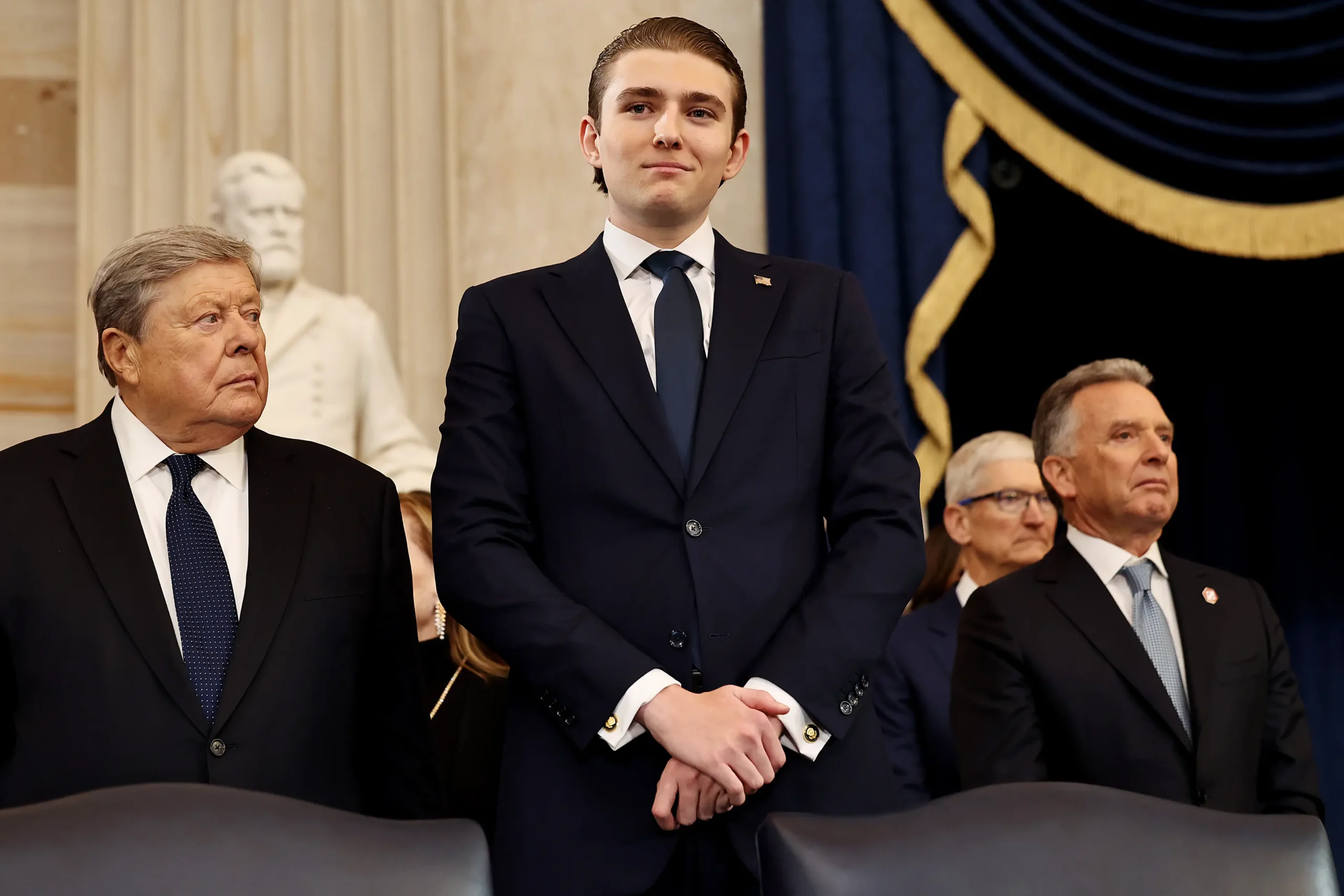
As the conflict intensifies and the prospect of a reinstated military draft grows, online discourse increasingly focuses on Barron Trump.
Internet users have begun to trend #SendBarron as a viral hashtag, demanding that authorities call him to serve if conscription returns. Critics argue that political leaders should face the same obligations as ordinary American families.
Comedian and former South Park writer Toby Morton has launched a dedicated website, Draftbarrontrump.com, to advocate for the president’s youngest son to serve.
Users flooded X with posts framing the demand in terms of fairness, insisting that those who order military action should bear personal stakes in its consequences. This conversation reflects a broader anxiety that has built since U.S. casualties began to mount.
Why the Casualties Made It Personal
In early March this year, the US Central Command confirmed that American service members had suffered casualties.
An Iranian drone struck a tactical operations center at Kuwait’s Shuaiba port, killing 6 service members. The drone’s projectile breached the air defenses and hit the building squarely in the center, leaving no time for the troops inside to evacuate.
By mid-March, the Pentagon reported a total of 13 U.S. military fatalities, including 6 crew members from the KC-135, marking the Air Force’s first combat losses in this conflict.
These numbers sparked intense discussions online. For families witnessing the rising casualty count, the question of who serves and who does not has become deeply personal and far from theoretical.
Why Barron Specifically
Barron Trump, currently 20 years old, studies at NYU’s Washington D.C.’s campus. U.S. law requires men aged 18 to 25 to register with the Selective Service System in case conscription is reinstated.
If Congress and the president decide to return to mandatory service, Barron’s age places him in the pool of potential draftees.
As the son of the sitting president, he attracts criticism from those who view Operation Epic Fury as a risk that average American families, rather than political figures’s families, must ultimately bear.
What the U.S. Draft Situation Actually Looks Like
If the government restores the draft, it will mark the first time the US has had an active draft since 1973. In December 2025, President Trump signed the FY2026 National Defense Authorization Act, which changed the Selective Service System and allocated a record $901 billion.
The government will automatically register qualified male U.S. citizens aged 18 to 25 using federal databases, replacing the former self-registration requirement starting December 18, 2026. As a result, conscription has not been reinstated.
Currently, no presidential order or congressional directive exists to bring the draft back. Any future movement toward a draft will require both an official presidential signature and clear congressional approval, as neither the legislative nor the executive branch can act alone.
The Online Conversation Escalates
A user expressed frustration: “If we put troops on the ground in Iran, then Barron Trump should be in uniform on the front lines too. The White House claimed, ‘He’s too tall to serve.’
They do everything to keep their kids safe while expecting ours to sacrifice their lives.” However, the claim about an official White House statement turned out to be false.
Grok fact-checked the allegation and found no such statement from the White House declaring Barron ineligible due to height.
The Height Rule That Changes Everything
The U.S. Army sets a maximum height of 80 inches (6 feet 8 inches) for male recruits aged 17 to 20, as outlined in Army Regulation 600-9. The Marine Corps and the Navy impose even stricter limits, capping male enlistees at 78 inches.
These height restrictions arise from the standardized engineering of military equipment; designers create hardware, from aircraft cockpits to M1 Abrams tank hulls, for individuals within the 5th to 95th percentile of the population.
As a result, Barron Trump’s reported height of 6 feet 9 inches exceeds the Army’s standard threshold by one inch. This discrepancy renders him ineligible for general enlistment in the Army or Navy unless he obtains a formal waiver.
Why Equipment Drives the Limit
The logic behind height caps is engineering, not aesthetics. Emergency escape hatches, ejection seats, and vehicle interiors are all sized to fixed dimensions.
A recruit who cannot fit safely into the machinery they operate becomes a safety liability to themselves and to their unit.
The Army’s physical standards are codified in AR 40-501, which details medical fitness requirements including height restrictions as a direct function of operational safety.
At the Military Entrance Processing Station, officials assess recruits by evaluating all physical and medical criteria before induction.
If recruits fall outside the approved range, they typically face rejection at that stage, unless they submit a formal waiver request that the relevant service branch approves.
The Waiver
Waivers exist and are granted based on well-documented precedents, with NBA Hall of Famer David Robinson serving as a prominent historical example. When Robinson entered the U.S. Naval Academy in 1983, he stood 6 feet 7 inches tall, one inch over the standing limit. The academy superintendent granted him an initial waiver.
By the time he graduated, he had grown to 7 feet and eventually reached 7 feet 1 inch, a height that Navy regulations deemed unsuitable for sea duty.
As a result, Secretary of the Navy John Lehman authorized him to fulfill a two-year active duty obligation in the Civil Engineer Corps, serving on shore duty at Georgia’s Naval Submarine Base Kings Bay.
Robinson’s experience clearly indicates that while exceptional height may change the nature of military service, it does not necessarily prevent it.
What a Waiver Would Mean for Barron
If a draft were reinstated and Barron Trump were called up, a height waiver process would apply to him. His reported height of 6 feet 9 inches is one inch above the Army ceiling, not categorically disqualifying across all branches or all roles.
Height waivers are evaluated case by case, based on overall physical fitness, the specific role a recruit would fill, and whether their dimensions are compatible with available equipment.
A draft waiver would travel a different procedural route, through MEPS and the relevant service’s waiver authority, rather than through an academy admissions process. The underlying logic, however, remains the same.
Extreme height may change the form military service takes, but it does not necessarily prevent it. The political optics of a sitting president’s son receiving such a waiver would be significant. The legal mechanism for that waiver already exists and carries clear historical precedent
The Numbers That Remain Disputed
Multiple sources report Barron’s height as 6 feet 7 inches instead of 6 feet 9 inches. At 6 feet 7 inches, Barron meets the Army’s standard, which employs a BMI-based screening, and he would encounter no height-based barrier to general enlistment.
The viral narrative of automatic ineligibility rested entirely on the higher figure. If that figure is wrong, the core medical argument dissolves.
Neither the White House nor any official military body has released a physical evaluation of Barron Trump, so the height debate remains grounded in publicly circulated estimates rather than verified data.
Donald Trump’s Own Draft History
Talks about Barron Trump are closely linked with President Trump’s own record from the Vietnam-era draft. While enrolled at Fordham University and the University of Pennsylvania, the elder Trump received 4 educational deferments.
Furthermore, he was granted a medical exemption in the fall of 1968 due to bone spurs in his heels. This diagnosis was provided by Dr. Larry Braunstein, a podiatrist in Queens who leased his office space from Fred Trump, the president’s father. Since Dr. Braunstein passed away in 2007, there are no available medical records to provide independent verification of the diagnosis.
What the Doctor’s Daughters Said
In 2018, Sharon Kessel and Elysa Braunstein, the daughters of the podiatrist who treated Donald Trump, told The New York Times that they considered the diagnosis of bone spurs to be “family lore.” They shared how their family preserved the story among friends as a piece of history.
Elysa Braunstein remarked, “I know it was a favor.” She explained that the arrangement allowed her father to have direct access to Fred Trump, who promptly resolved building maintenance issues in exchange for the professional courtesy.
Elysa also expressed uncertainty about whether her father ever physically examined Donald Trump. The Times could not find supporting medical records from the family, the doctor who later acquired Braunstein’s practice, or the National Archives.
Trump Has Acknowledged the Doctor’s Note
President Trump has admitted that a doctor issued him the bone spur documentation used for his draft exemption, though he told The New York Times during his 2016 campaign that he could not recall the physician’s name and lacked the original records.
Bone spurs, which are painful calcium build-ups on the heel, became a focal point for critics who doubt the diagnosis’s validity given its timing and the lack of verifiable evidence. These skeptics question whether the medical condition was a genuine barrier to service or a strategic maneuver to avoid the draft.
What the Rules Say and What They Don’t
Several claims circulating on X during the debate were false or unverifiable. The White House issued no statement declaring Barron ineligible for military service.
No official medical evaluation of Barron Trump’s fitness for service has been conducted or released publicly. His reported height figures vary across sources, with some placing him at 6 feet 7 inches and others at 6 feet 9 inches.
The distinction between those 2 figures is the difference between standard eligibility and requiring a waiver. The viral narrative of automatic exemption rested on the higher number and drew conclusions that the formal rules do not fully support at the lower measurement.
Who Would Actually Be Registered
Under the FY2026 NDAA signed in December 2025, the Selective Service System will use federal databases to automatically register eligible males between 18 and 25, starting December 2026.
The Center on Conscience and War has noted that implementation will involve cross-matching data with federal agencies, with the information subsequently shared with military recruiters. Crucially, the current law still applies only to males.
The Senate Armed Services Committee proposed to extend registration to women in the FY2025 NDAA, but the final signed version did not include that amendment.
Currently, the law does not require women to register, but the Selective Service System has stated it is ready to expand registration if the law changes.
What Would Actually Happen in a Draft
If the United States reinstated conscription, the Selective Service System’s own guidance outlines a precise sequence.
Congress and the president would first authorize the draft jointly. The Selective Service would then activate all personnel.
A nationally televised lottery based on dates of birth would determine the order of induction. Barron Trump would participate in that lottery like every other eligible male.
If his number came up, he would report to a Military Entrance Processing Station for physical and medical evaluation.
His height would be measured and assessed against the standards of the branch he was assigned to. If he exceeded the standard limit, a waiver could be requested and adjudicated based on his broader fitness profile and the roles available to him.
That is the process. It contains no special carve-outs for political families, but it does contain the same case-by-case judgment that Robinson’s waiver relied on in 1983.
The Question Underneath the Debate
Operation Epic Fury has escalated steadily since the initial strikes. By mid-March 2026, the Pentagon confirmed it had struck over 7,000 targets across Iranian military infrastructure, including underground facilities, naval assets, and missile production sites.
Iran’s retaliatory activity has spread across Iraq, the UAE, Saudi Arabia, and Lebanon, with no immediate signs of resolution. Against that backdrop, the Barron Trump debate will not fade. The rules do not formally exempt him from military service.
However, the combination of disputed height figures, existing waiver mechanisms, and a family history of medical deferments gives critics a credible framework for skepticism, even when the legal reality is far more nuanced than any trending hashtag can hold