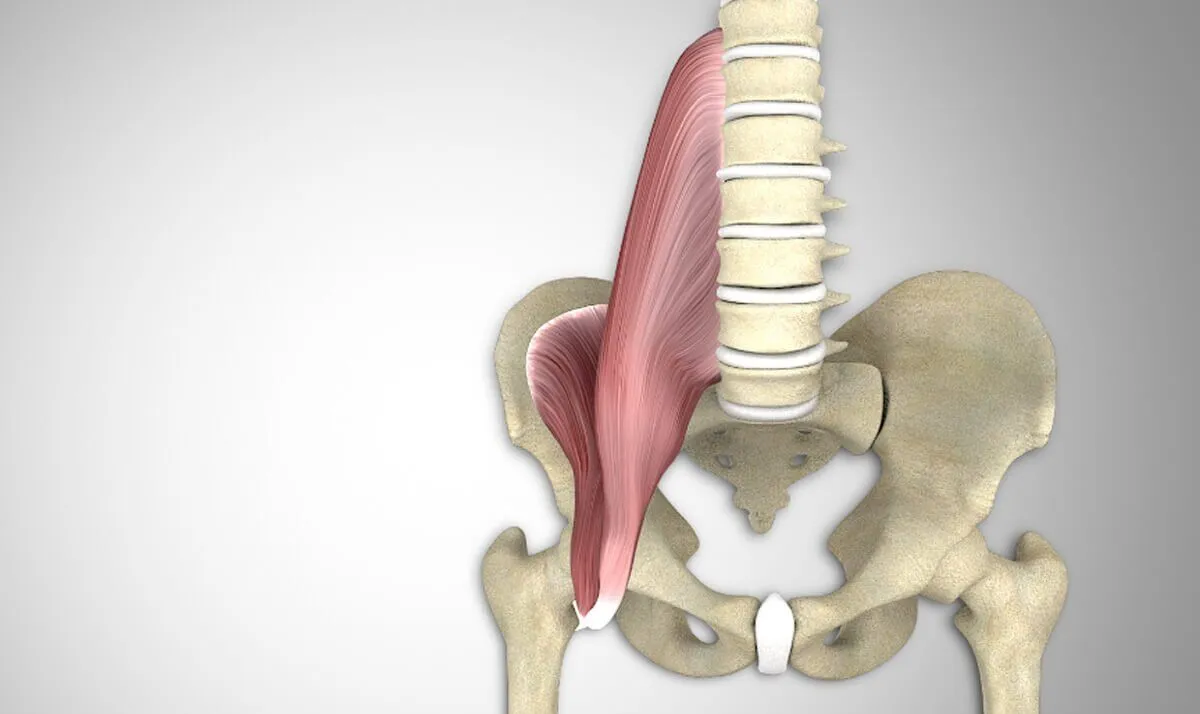
The psoas is not a hidden cause of every protruding belly or episode of back pain, and claims that simply “releasing” one muscle will flatten the stomach are exaggerated. However, when the psoas and surrounding hip muscles become stiff or overworked, they can influence pelvic position, hip mobility, and how the lower back feels. Understanding this relationship can help explain why prolonged sitting, limited hip movement, and poor movement habits sometimes produce a combination of tight hips, a stiff back, and a belly that appears more prominent.
1. What Exactly Is the Psoas Muscle?
The psoas major is a deep muscle located inside the abdomen and pelvis. It begins along the lumbar spine and runs downward through the pelvis before attaching to the upper part of the femur, or thigh bone. Together with the iliacus muscle, it forms an important hip-flexor group known as the iliopsoas.
Its main job is to help flex the hip, which means bringing the thigh toward the torso. It is active when you walk, climb stairs, run, or lift your knee. Because of its attachment near the lumbar spine, it also interacts with the structures responsible for stabilizing the trunk and pelvis.
2. Why Sitting for Long Periods Can Affect It
When you sit in a chair, your hips remain in a flexed position for long stretches of time. If much of your day is spent sitting at a desk, driving, gaming, or using a computer, the hip flexors repeatedly remain in a shortened position.
This does not necessarily mean the psoas permanently “shrinks,” but the body can become accustomed to the limited position. Hip extension may feel restricted, and standing upright after hours of sitting may create a sensation of tightness across the front of the hips or stiffness through the lower back.
People who sit frequently may also use their gluteal and abdominal muscles less effectively during daily movement, creating an overall pattern in which the hips and lower back compensate for muscles that are not contributing as efficiently as they could.
3. How the Psoas Can Influence Pelvic Position
The pelvis is influenced by many muscles, including the hip flexors, abdominal muscles, glutes, hamstrings, and muscles of the lower back. When these muscle groups are not working together effectively, the pelvis may rest in a position that exaggerates the natural curve of the lower spine.
This is sometimes described as an anterior pelvic tilt. In this posture, the front of the pelvis tips slightly downward while the back rises. The lower back may appear more arched, the buttocks may project backward, and the abdomen may appear to push forward.
The psoas can contribute to this pattern, but it is rarely the only muscle involved. Posture results from a combination of anatomy, muscle control, mobility, daily habits, and individual body structure.
4. Why the Lower Belly May Look More Prominent
A protruding abdomen does not automatically mean there is excess abdominal fat. The position of the rib cage, spine, and pelvis can change the way the abdomen looks even when body composition remains the same.
If the lower back is excessively arched and the pelvis is tilted forward, the abdominal wall may project outward. Someone may therefore notice that their lower stomach appears larger when standing naturally but looks noticeably flatter when they consciously adjust their posture.
This does not mean posture is responsible for every lower-belly bulge. Body fat distribution, bloating, digestive issues, pregnancy-related changes, abdominal muscle separation, and normal anatomy can all affect the appearance of the abdomen.
5. A Stiff Psoas May Be Felt More as Hip Tightness Than Belly Tightness
Because the psoas lies deep inside the body, most people cannot clearly identify it the way they might feel a tight calf or shoulder muscle. Instead, stiffness around the hip flexors may feel like tightness at the front of the hip, difficulty extending the leg behind the body, or stiffness after standing up from prolonged sitting.
Some people also notice that their lower back feels unusually tense after sitting for several hours. In those cases, limited hip mobility may force the lumbar spine to move more during walking, standing, or exercise.
6. Why Your Lower Back May Feel Constantly Tight
A stiff lower back does not always mean the back muscles themselves need to be stretched. Sometimes the muscles are working hard to stabilize a pelvis and hips that are not moving efficiently.
If the hip flexors are tight and the glutes and abdominal muscles are not contributing effectively, the muscles surrounding the lumbar spine may remain active for long periods. This can create the familiar sensation of tightness, fatigue, or aching across the lower back.
That is one reason endlessly stretching the back may provide only temporary relief. Improving hip mobility, strengthening the surrounding muscles, and reducing prolonged sitting may be equally important.
7. Weak Abdominal Muscles Can Add to the Problem
The appearance and position of the abdomen are influenced by much more than the psoas. Deep abdominal muscles help control the trunk and pelvis during standing and movement.
If these muscles are weak or poorly coordinated, the pelvis and rib cage may be less stable. The stomach may appear to relax forward, particularly when combined with an exaggerated lower-back arch.
This is why hundreds of traditional crunches are not necessarily the answer. Exercises that teach the abdominal wall to stabilize the trunk, such as controlled dead bugs, planks, and other core-stability movements, may be more useful for posture and movement control.
8. Weak Glutes May Also Be Part of the Picture
The gluteal muscles play an important role in extending the hip and controlling the pelvis. When they are not contributing effectively, the hip flexors and lower-back muscles may take on more work.
Long periods of sitting can reduce how often the glutes are challenged throughout the day. Strengthening them with exercises such as bridges, squats, step-ups, and controlled hip-hinge movements can help restore balance around the hips.
The goal is not to “turn off” the psoas. The psoas is an essential muscle. The goal is to make sure it is working as part of a coordinated system rather than compensating for weaknesses elsewhere.
9. Stretching the Hip Flexors May Help—But Technique Matters
A gentle hip-flexor stretch can be useful for people who spend much of the day sitting. A common version involves kneeling on one knee, placing the opposite foot in front, and gently moving the pelvis forward until a stretch is felt at the front of the hip.
However, simply arching the lower back during the stretch can defeat the purpose. Keeping the pelvis controlled and the ribs stacked over the hips generally allows the stretch to target the hip region more effectively.
Stretching should feel gentle rather than painful. Aggressive stretching is unnecessary and can irritate sensitive tissues.
10. Getting Up More Often May Matter More Than One Long Stretch
If you sit for eight or ten hours a day, stretching for two minutes before bed may not completely offset the effect of spending most of the day in the same position.
Breaking up sitting time can be more practical. Standing, walking around, gently extending the hips, or changing position every so often gives the body regular opportunities to move through a wider range of motion.
Even brief movement breaks can reduce the feeling of stiffness that develops after remaining stationary for long periods.
11. Breathing and Rib Position Can Change the Appearance of the Belly
Posture is not just about the pelvis. The position of the rib cage also influences the abdominal wall. Some people habitually stand with the ribs flared upward and the lower back excessively extended.
When the ribs and pelvis are poorly aligned, the abdomen may appear more prominent. Learning to breathe normally while maintaining a relaxed, stacked rib cage and pelvis can sometimes change the appearance of the torso without any change in body fat.
This should not involve constantly sucking in the stomach. The goal is relaxed control rather than holding tension all day.
12. A Simple Routine May Help Restore Better Movement
For someone whose symptoms are related mainly to prolonged sitting and stiffness, a balanced approach may include gentle hip-flexor mobility, glute strengthening, core-stability exercises, regular walking, and frequent breaks from sitting.
Rather than obsessing over one muscle, think of the hips, pelvis, abdomen, and spine as a connected system. Improving movement in one area while strengthening another often works better than repeatedly trying to stretch the psoas alone.
13. A Protruding Belly Is Not Always a Posture Problem
It is important not to assume that every lower-belly bulge comes from a tight psoas or pelvic tilt. Normal fat distribution is extremely common, and the lower abdomen naturally contains organs and other tissues that contribute to its shape.
Bloating, constipation, abdominal muscle separation, hernias, hormonal changes, pregnancy, and other medical conditions can also affect abdominal appearance. If the abdomen becomes suddenly enlarged, painful, unusually firm, or associated with digestive symptoms or unexplained weight changes, it is worth discussing with a healthcare professional.
14. Back Pain Has Many Possible Causes
Similarly, persistent lower-back pain should not automatically be blamed on the psoas. Back discomfort can come from muscles, joints, discs, nerves, injuries, inflammatory conditions, or other causes.
Seek medical evaluation if back pain is severe, follows a significant injury, continues to worsen, travels down the leg, causes weakness or numbness, or is associated with loss of bladder or bowel control. Those symptoms require more attention than simply stretching at home.
The Bottom Line
The psoas is an important muscle connecting the lower spine, pelvis, and legs, and it can influence how your hips and lower back move. When prolonged sitting, limited hip mobility, weak glutes, reduced core control, and certain postural habits occur together, the lower back may feel stiff and the abdomen may appear more prominent.
But there is rarely one muscle responsible for the entire problem. Instead of trying to “release” the psoas as a quick fix, focus on the bigger picture: move more frequently, improve hip mobility, strengthen your glutes and core, and pay attention to comfortable posture.
If your belly appears flatter when you gently reposition your pelvis and rib cage, posture may be contributing to its appearance. And if your lower back frequently feels stiff after hours of sitting, your hips may benefit from more movement. Small changes performed consistently can often make a much bigger difference than aggressively stretching one supposedly troublesome muscle.